



Hydrogen is moving from ambition to execution. With technologies maturing and industrial projects advancing, the next challenge is becoming clear: delivering hydrogen projects reliably, repeatedly and at scale.
The question is no longer only whether hydrogen technology works, but how effectively complete systems can be integrated, commissioned, maintained and deployed across successive projects.
In the early hydrogen market, technical performance was the main differentiator.
Efficiency, stack development and system performance remain important, but industrial scale-up brings a broader set of challenges.
Project teams now need to understand:
These questions influence engineering effort, commissioning time, project risk and deployment cost.
“For years, the hydrogen discussion focused on proving technology. Today, the challenge is shifting towards execution. As projects become larger, success depends on how effectively systems are integrated, commissioned and deployed again. That is where operational experience becomes a real advantage.”
Bart de Vries, Business Development Manager Hydrogen, VONK
A hydrogen project depends on more than individual component performance.
Power conversion, control, grid interfaces, cooling, safety and plant infrastructure must work together under real operating conditions.
Even strong technology can create delays when integration requires extensive custom engineering or lengthy commissioning.
As projects grow, delays increasingly arise at the interfaces between systems, organisations and site requirements. Deployment capability therefore becomes a condition for scale, not simply an operational advantage.
Real projects show where deployment capability makes the difference.
Integration
Optimised components are not always easy to integrate. Successful deployment depends on solutions that fit site conditions, existing infrastructure and project constraints.
Interfaces
Predictable interfaces reduce engineering effort and make deployment more repeatable.
Commissioning
The period between installation and operation has a direct impact on schedules and costs.
Repeatability
Growth requires systems that can be deployed again without reinventing the engineering approach for every project.
The next phase of hydrogen will be shaped by organisations that combine technical expertise with deployment capability.
For project owners, electrolyser manufacturers and EPC contractors, this means looking beyond performance figures alone. Scalability depends on systems that are reliable, maintainable and practical to deploy.
At VONK, we work where power conversion, control systems and plant integration come together. In hydrogen projects, we see a growing need for solutions that reduce technical risk, simplify integration and support repeatable deployment.
That combination will be essential as hydrogen moves from ambition to execution.
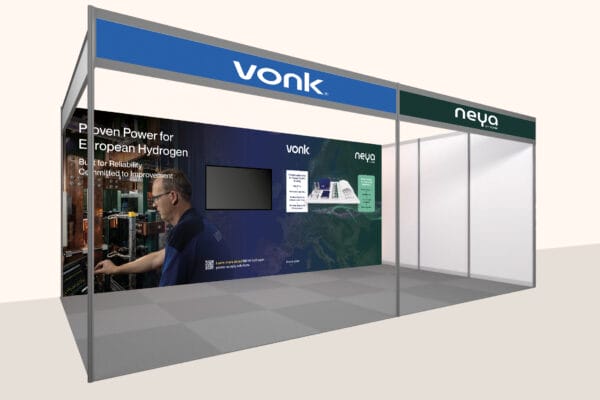
VONK welcomes conversations with electrolyser manufacturers, EPC contractors, developers and end users preparing for industrial-scale hydrogen deployment. Meet us at Hydrogen Technology Expo Europe in Hamburg or contact Bart de Vries, Business Development & Sales Manager: bart.devries@iivonk.com
Also visit our NEYAbyVONK website.